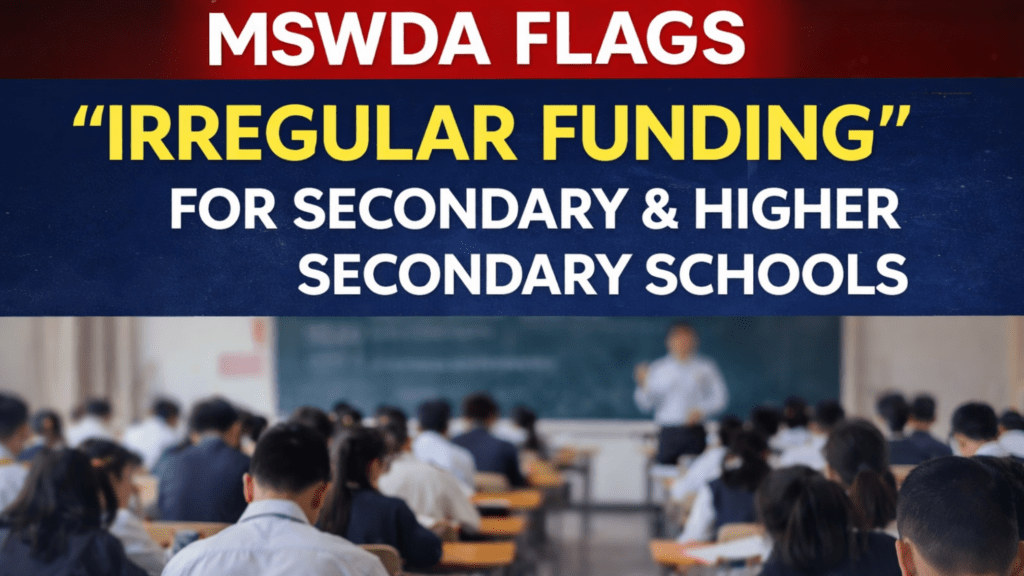
Shillong, March 30: The Meghalaya School Welfare Development Association (MSWDA) has raised serious concerns over what it termed as irregular and inadequate government support to Secondary and Higher Secondary schools across the state.
Citing data from the Directorate of School Education and Literacy (DSEL), MSWDA revealed significant gaps in funding distribution : Higher Secondary Schools: 29 Government schools, 17 Deficit schools. Secondary Schools: 121 Deficit schools, 9 Deficit Pattern schools, 382 schools receiving both Adhoc Grant (for general teachers) and Science Grant and 219 schools receiving only Science Grant, without Adhoc support for other teachers. MSWDA President Hamarbamut Marbaniang said this uneven allocation reflects a lack of systematic policy.
The Association stated that despite repeated appeals by recognized schools through District School Education Officers (DSEO), many institutions continue to be denied financial aid. “The government has repeatedly rejected proposals without properly assessing the needs. If even a few deserving schools were supported over time, the situation would have improved,” Marbaniang said.
MSWDA also criticized the government for creating disparities among teachers: 219 schools receive funding for only one Science teacher and Other teachers in the same schools receive no Adhoc Grant. “This discriminatory approach affects morale, administration, and overall functioning of schools,” the Association said, adding that many institutions have been deprived of Adhoc grants for over 20 years, despite being eligible since 2013–14.
The Association further alleged that the government appears to prioritize lower classes (up to Class VIII), while neglecting Secondary and Higher Secondary education. “It is not enough to focus only on lower levels. The real outcome of education is reflected in SSLC and HSSLC results,” Marbaniang noted.
MSWDA highlighted that schools in rural areas face greater challenges, as parents are unable to afford high fees, making government support crucial. The lack of funding, the Association warned, is impacting the quality of education and availability of qualified teachers in higher classes.
The Association also raised concerns regarding 1,544 SSA schools (835 LP and 709 UP) that have not handed over management: 110 schools in Garo Hills, 1,434 in Khasi and Jaintia Hills. MSWDA questioned the government’s clarity on Recognition status of these schools and Appointment of replacement teachers, which is currently on hold.
To deliberate on these issues, MSWDA will hold a meeting on April 6 at Khasi National Durbar Hall, Mawkhar. All school authorities, principals, headmasters, and teachers from affected Secondary/Higher Secondary and SSA schools have been invited to attend.