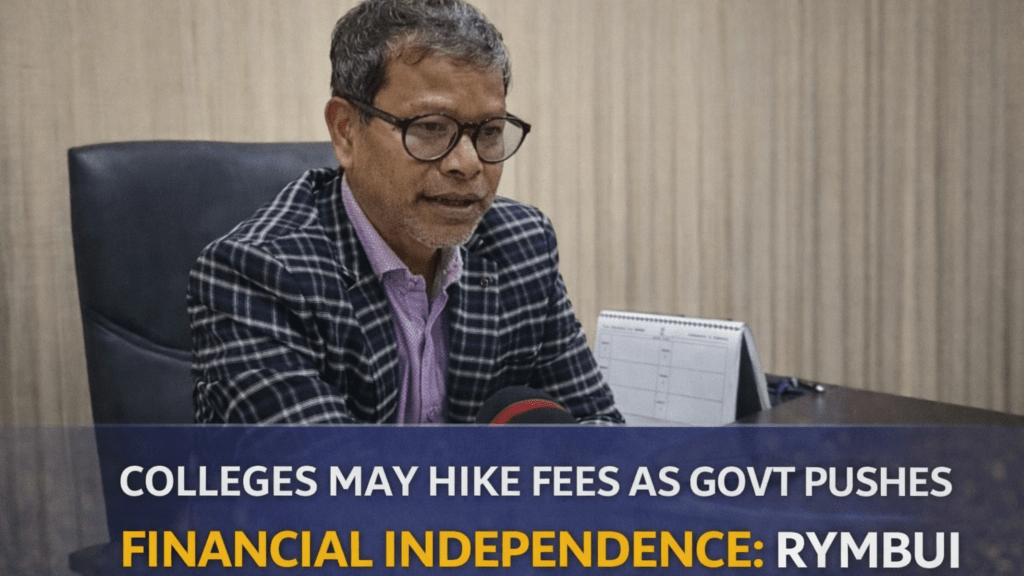
Shillong, April 2: Education Minister Lahkmen Rymbui has said that the state government is considering a revision of fees in government colleges as part of efforts to reduce dependence on government grants and enable institutions to manage routine expenses independently.
Speaking after a review meeting on Thursday, Rymbui pointed out that fees in government colleges remain significantly lower than those in deficit and private institutions, limiting the flexibility of principals. “We cannot deny the fact that the fees in government colleges are very less compared to people’s colleges or deficit colleges,” he said. Under the proposed model, colleges may increase fees by 10–15 percent, with the additional amount to be paid after students receive post-matric scholarships.
Explaining the proposal, the minister said “Suppose a college collects Rs 11,000 or Rs 12,000 now; let us make it Rs 18,000–19,000. The student pays what they can now, and the rest after the scholarship comes.” He emphasised that the move would not burden students, as post-matric scholarships are directly credited to colleges. “This will not put a burden onto the student because the government will reimburse,” he added.
Rymbui cited Kiang Nangbah Government College as an example, stating that an increase of Rs 8,000 per student across 3,000 students could generate around Rs 2.4 crore annually. This additional revenue would allow colleges to independently fund College week and events, Excursions and Hiring of new teachers. “With this fund, the college will not come to us to sanction money,” he said.
To ensure proper utilisation of funds, the minister said each college would be required to form a committee comprising faculty and student representatives. “Whatever they use, they should use it for the betterment of education,” he stated.
Rymbui also urged colleges to Obtain UGC 12B and 2F recognition, Pursue accreditation and self-assessment. He stressed that such measures help the government better target support and improve education standards.
Turning to school education, the minister directed officials to introduce two parent-teacher meetings annually in government schools—during mid-year results and before final exams. “We want a sense of belonging and ownership,” he said, noting that government schools often lack community involvement.
Rymbui clarified that while some proposals could be implemented immediately, others would require further consultation. “We are here to serve the people of the state, and anything we do, we do for betterment,” he said.
The proposed reforms are aimed at creating financially independent and better-managed educational institutions, while ensuring that students continue to receive adequate support through scholarships.