
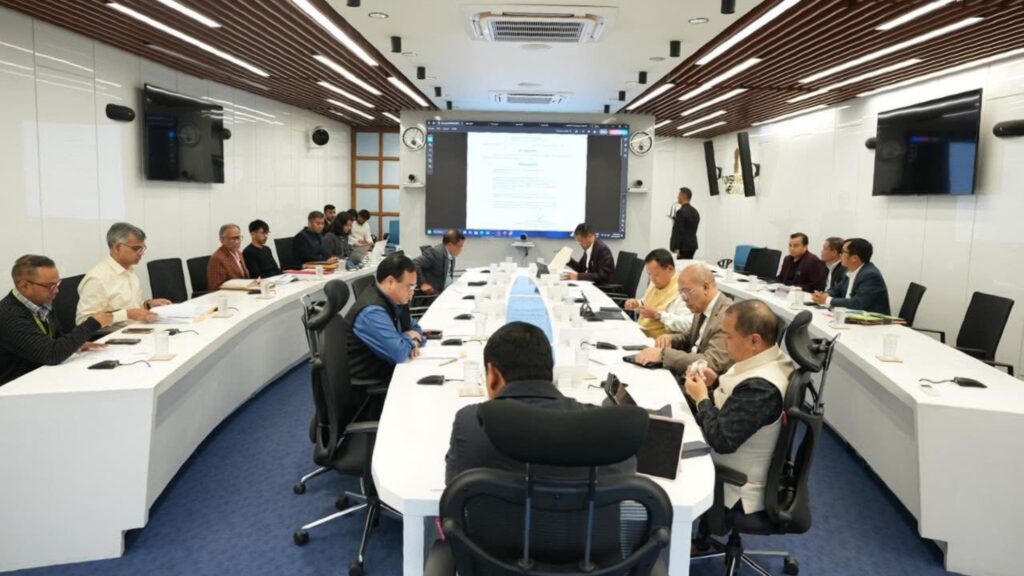
Shillong, May 27: The Meghalaya Government has introduced a Unified Regulatory Framework for private nursing institutions in the state to strengthen quality control, transparency, and employability standards in nursing education under the Directorate of Medical Education & Research, Health & Family Welfare Department.
According to a notification issued by the Health & Family Welfare Department on May 27, the government said the number of private nursing schools and colleges in Meghalaya has increased significantly over the past decade, raising concerns over infrastructure adequacy, availability of qualified faculty, clinical training facilities, and transparency in admission and fee structures.
The framework aims to establish a single-window approval and monitoring system for all private nursing institutions in Meghalaya through the Directorate of Medical Education & Research. The government stated that the move is intended to ensure compliance with standards prescribed by the Indian Nursing Council (INC) and Meghalaya Nursing Council (MNC), while also safeguarding the quality of nursing education and patient safety.
Under the new framework, a statutory body called the Meghalaya Nursing Education Regulation Authority (MeNERA) will be constituted with powers to grant approvals, conduct inspections, regulate fee structures, enforce educational standards, and ensure placements for graduates. Existing legislations, including the Meghalaya Nursing Council Act, will also be amended to incorporate the unified regulatory mechanism.
The government has laid down a five-step approval process for nursing institutions, beginning with the issuance of Essentiality Certificates or No Objection Certificates (NOC) by the Health & Family Welfare Department through the Directorate of Medical Education & Research after inspection and need assessment. This will be followed by recognition from the Meghalaya Nursing Council, statutory inspection by the INC, academic affiliation by universities, and inclusion of approved seats in the state counselling and admission matrix.
The framework also mandates strict adherence to INC norms related to infrastructure, faculty-student ratios, clinical facilities, and skill laboratories. Institutions will be required to establish modern skill and simulation labs, provide continuous faculty training, and maintain proper monitoring of clinical exposure and practical hours for students.
To improve employability, every institution must create a Placement and Career Guidance Cell and maintain linkages with hospitals, NGOs, and healthcare providers for structured placements. The government has also proposed annual nursing job fairs and a graduate tracking system to monitor employment outcomes.
The notification further stated that fees will be regulated by a State Fee Fixation Committee notified by the Health & Family Welfare Department, while capitation fees and unauthorised charges will be prohibited. Admissions are to be centralized or merit-based to ensure fairness and transparency, with entrance examinations conducted by the Directorate of Medical Education & Research.
Periodic inspections by the Meghalaya Nursing Council and affiliated universities will be mandatory, and institutions failing to comply with the regulations may face penalties, intake reduction, suspension, or withdrawal of recognition. The framework will be implemented in phases with immediate enforcement of baseline standards, inspection mechanisms, and disclosure norms.