New Delhi, August 4: The Indian Council of Agricultural Research has developed India’s first indigenous vaccine against African Swine Fever, marking a major breakthrough in veterinary science and the country’s efforts to strengthen animal health and biosecurity. Union Agriculture Minister Shivraj Singh Chouhan, in the presence of Union Minister Rajiv Ranjan Singh, dedicated the vaccine to the nation during this year’s ICAR Foundation Day.
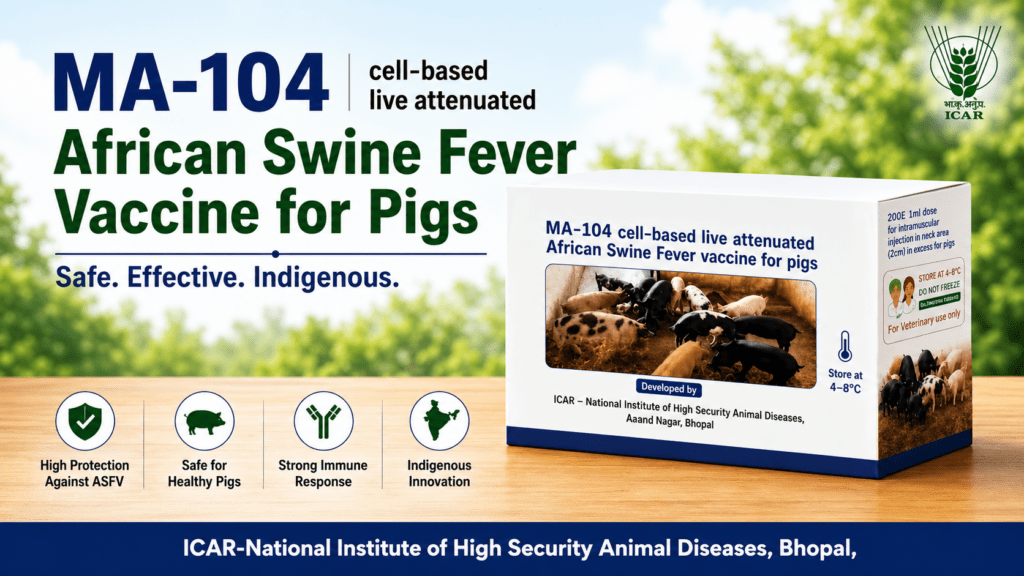
Developed by the ICAR–National Institute of High Security Animal Diseases in Bhopal, the vaccine is an MA-104 cell line-based live attenuated vaccine designed to protect pigs against African Swine Fever. ASF is a highly contagious viral disease affecting domestic and wild pigs. It is characterised by high fever, haemorrhages and mortality rates that can approach 100 per cent. Since its first detection in India in 2020, the disease has spread to several states and Union Territories, causing large-scale pig deaths, restrictions on animal movement and trade, and severe livelihood losses for farmers, particularly in the Northeast.
During the initial outbreaks in Assam in 2020 and 2021, pig mortality and culling reportedly caused losses of around ₹276 crore. In Mizoram, outbreaks had affected more than 11,382 households up to 2025, resulting in estimated financial losses of nearly ₹982 crore. Until now, disease control in India largely depended on early diagnosis, culling of infected animals and strict biosecurity measures due to the absence of an effective treatment or commercially approved domestic vaccine.
According to ICAR, the newly developed vaccine uses a novel attenuated Genotype II African Swine Fever virus with specific gene deletions and is suitable for large-scale production. The vaccine underwent laboratory evaluation for sterility, purity, safety, genetic stability, immunogenicity, protective efficacy and the possibility of virulence reversion. It was also field-tested in collaboration with the Department of Animal Husbandry and Dairying. The vaccine is recommended for healthy pigs above eight weeks of age. It is administered through a 1-millilitre intramuscular injection, followed by a booster dose after 14 days.
ICAR said the vaccine is expected to reduce pig mortality, limit financial losses and protect the livelihoods of pig farmers. It is also expected to support the sustainable growth of India’s pig-farming sector.
ICAR Director General and Department of Agricultural Research and Education Secretary M.L. Jat described the development as the beginning of a new era in veterinary science and said it reflected India’s growing capacity to develop world-class animal-health technologies.
Unlike the limited commercially licensed ASF vaccines currently available in Vietnam, which depend on proprietary cell lines, the Indian vaccine uses the widely available MA-104 cell line. This is expected to reduce dependence on patented production platforms, lower manufacturing costs and enable large-scale production.
The development is being seen as a significant step towards Atmanirbhar Bharat in veterinary vaccine manufacturing and could position India as a global supplier of affordable ASF vaccines.