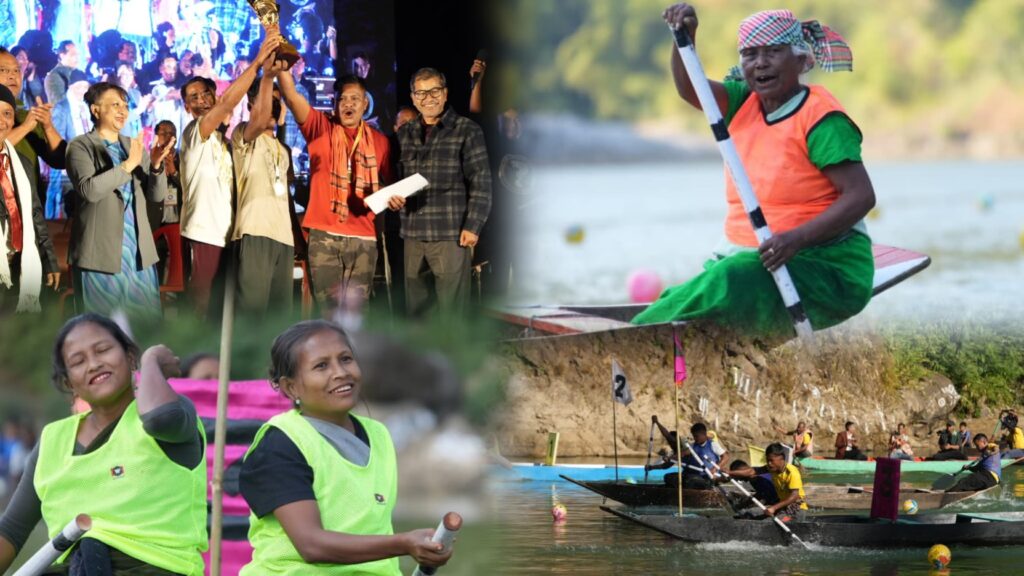
Shillong, December 15 : After a gap of nearly three decades, the once-famous Umngot Boat Race—locally known as Sport Lieng—was revived at Darrang on December 12 and 13, bringing back a long-forgotten traditional sport of the Khasi–Jaintia communities living along the banks of the Umngot River. The historic event was held as part of the 4th edition of the Tri Hills Festival and marked a significant moment in Meghalaya’s cultural revival.
The boat race, deeply rooted in the riverine culture of the region, had last been organised in 1997 at Dawki on the Umngot River. Its revival after 28 years drew a large number of spectators and recorded the highest participation ever, surpassing even the races held nearly three decades ago.
The event was organised by the Elaka Darrang with support from the Department of Arts and Culture, Government of Meghalaya. The race was formally flagged off by Frederick Roy Kharkongor, Principal Secretary, Arts and Culture Department, Government of Meghalaya, along with Eoghan O’Regan, Head of the Welsh Government at the British Deputy High Commission. The occasion was graced by the presence of P. Lymba, Dolloi of Elaka Darrang, Alan West Kharkongor, President of the Meghalaya River Tourism Forum (MRTF), and several other dignitaries.
In his inaugural address, Kharkongor expressed his joy and satisfaction at the successful revival of one of Meghalaya’s lost traditional sports. He said that the Tri Hills Festival is not merely a platform for celebration and entertainment, but a meaningful initiative aimed at protecting, conserving, and enriching the state’s rich and diverse cultural heritage.
O’Regan, in his address, praised Meghalaya’s natural beauty—its hills, landscapes, and rivers—and emphasised the importance of preserving such indigenous traditions and passing them on to future generations.
Alan West Kharkongor, who conceptualised and curated the even along with his team at Weskin Enterprise, stated that this year’s Tri Hills Festival was deliberately taken outside Shillongwith the objective of rediscovering and showcasing the state’s lesser-known cultural traditions. He noted that the Umngot Boat Race symbolises the deep spiritual and cultural relationship between the people and their sacred rivers, where activities such as boating, swimming, and water diving were once an integral part of daily life.
The Umngot Boat Race witnessed enthusiastic participation from residents of Darrang, Dawki, and Shnongpdeng. Boatmen and boatwomen, youths, children, and elders alike registered and competed not only in the boat races but also in other water-based activities, including water polo. Notably, a few participants who had taken part in the last boat race held in 1997 also competed this year. Now aged over 80, they expressed immense joy and gratitude at being able to relive a tradition they believed they would never witness again.
In the men’s category, the first prize was won by Charlie Ryngksai and his team, followed by Barist Pohktai in second place, and Henry Ryngksai and team securing third position. In the women’s category, the Shibakha team emerged as winners, while the second prize was claimed by Geeting Kongwangand the third prize by Rose Ryngksai and her team.
Education Minister and local MLA Lahkmen Rymbui attended the prize distribution ceremony and presented the awards to the winners along with the Director of Arts and Culture, Iadashisha Majaw.
The celebrations concluded with a vibrant musical extravaganza in the evening, where local artists and bands such as Na U Bnai, Pynter Orchestra, Dalariti, Enibha War, Sur Na Nongkyndong, Khun U Woh, Summersalt, and Snowhite enthralled the audience, adding a festive finale to the historic revival of the Umngot Boat Race.