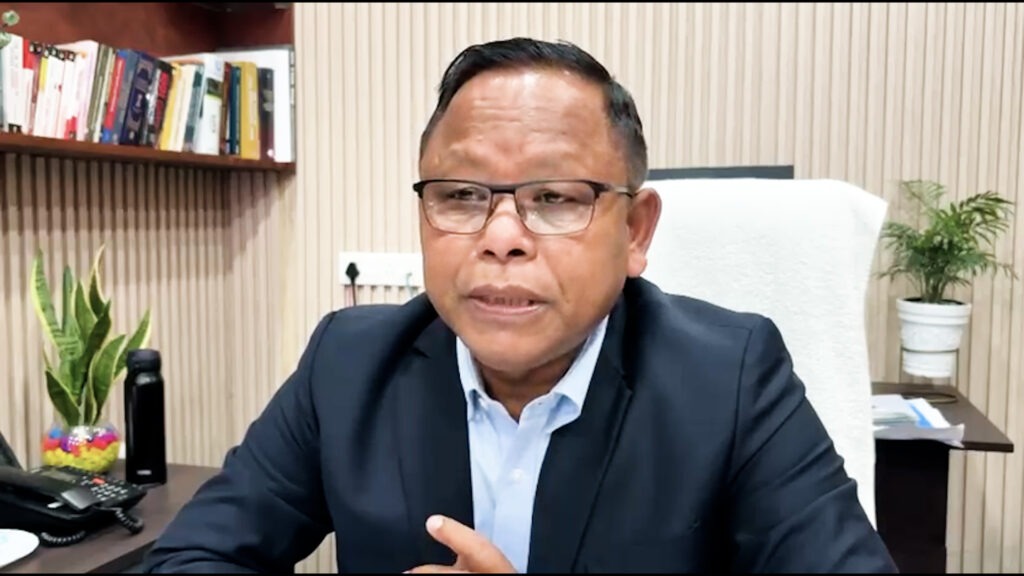
Shillong, April 30: The Meghalaya government has intensified efforts to improve the functionality of Jal Jeevan Mission (JJM) projects, with Public Health Engineering (PHE) Minister Marcuise N Marak directing all Deputy Commissioners (DCs) to conduct monthly District Water and Sanitation Committee (DWSC) meetings and upload reports on the Centre’s IMIS portal for real-time monitoring.
Speaking to reporters after chairing a review meeting on Thursday, Marak informed that the process of creating IDs for JJM infrastructure is at an advanced stage, as mandated by the Government of India. He stated that IDs have already been generated for out-village infrastructure covering 6,772 habitations through 1,931 IDs, while 51 IDs are still pending. For in-village infrastructure, 1,570 IDs have been created covering 2,500 habitations, with only 89 IDs remaining at the draft stage.
The minister emphasised the crucial role of DCs, who serve as chairpersons of the DWSCs, in ensuring effective monitoring and accountability at the grassroots level. He said monthly meetings are mandatory, and the proceedings must be uploaded on the IMIS portal to enable the Centre to track progress and follow up on implementation. Marak highlighted the importance of field-level engagement, stating that DCs, along with gram sevaks, must assess whether village water and sanitation committees are properly managing completed projects and encourage them to take ownership for long-term sustainability.
To address technical challenges, the state has established district technical units tasked with identifying issues and reporting them to DCs, who will then escalate them to the state government. Referring to reports of pipelines being laid without water supply, the minister said DWSCs have been instructed to investigate the causes, including possible source issues or lack of maintenance.
He also acknowledged that reluctance among local committees to take ownership of projects has affected functionality in some areas. Marak clarified that monitoring will cover both ongoing and completed projects, stressing that the government is committed to ensuring all JJM infrastructure becomes fully functional.
Responding to criticism over the scheme’s performance, he asserted that the government will not abandon any project and is determined to ensure their effectiveness.
The minister further called for cooperation from all stakeholders, noting that while the PHE department alone cannot address all challenges, coordinated efforts involving DCs, BDOs, and other state agencies will help improve implementation and sustainability of JJM projects across the state.