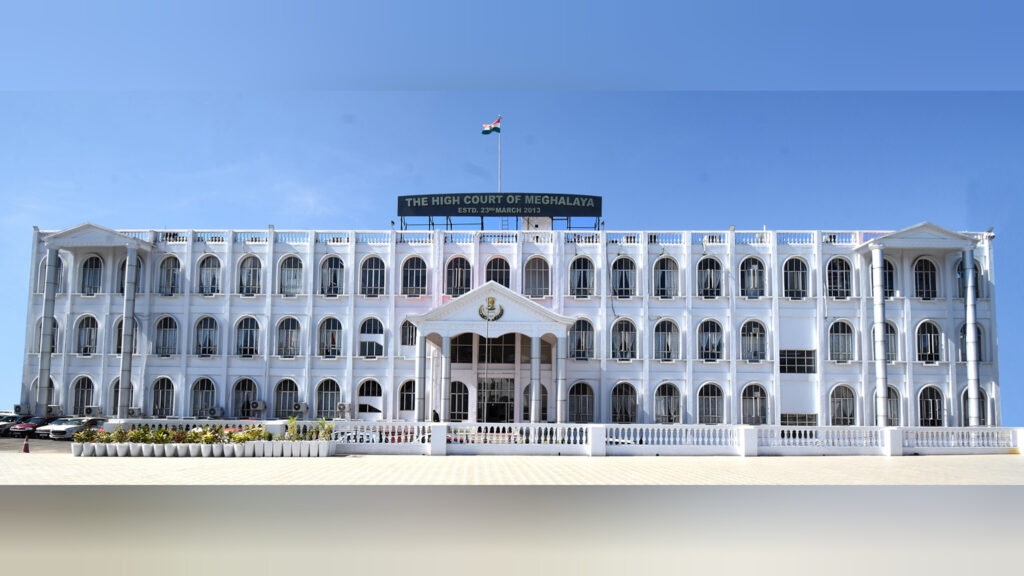
Shillong, April 17, 2026: The High Court of Meghalaya has dismissed a Public Interest Litigation (PIL) challenging the proposed Greenfield High-Speed Highway Corridor project in Ri-Bhoi district, while directing authorities to strictly adhere to environmental and statutory safeguards.
The PIL, filed by petitioner Shri Pynskhemlang Sohtun, had sought halting of land acquisition, surveys, and preparatory works for the 166.8 km highway project, citing concerns over ecological damage, landslides, and impact on tribal and culturally sensitive areas.
A division bench comprising Chief Justice Revati Mohite Dere and Justice W. Diengdoh, after examining affidavits and submissions from the State and central authorities, found no merit in the petition at this stage.
The court noted that the National Highways and Infrastructure Development Corporation Limited (NHIDCL) had incorporated detailed environmental safeguards in the project’s Detailed Project Report (DPR), including provisions for drainage systems, slope stabilization, wildlife crossings, and protection of water bodies.
Authorities also informed the court that the project, approved by the Cabinet Committee on Economic Affairs in May 2025, aims to boost connectivity between Shillong, Guwahati, and Silchar, enhancing trade, logistics, and regional development.
Addressing concerns raised in the PIL, the government clarified that the proposed alignment avoids the core sacred site of Lum Sohpetbneng and that public consultations were held with village headmen, leading to modifications in the alignment to minimize impact on water sources and agricultural land.
The High Court emphasized that all environmental safeguards, including those outlined in the Standard Operating Procedure issued by the Ministry of Environment, Forest and Climate Change, must be followed rigorously during construction and operation of the project.
“Authorities have assured to scrupulously follow all statutory requirements and environmental safeguards. We find no merit in the PIL at this stage,” the court observed.
However, the court granted liberty to the petitioner to approach the court again if any fresh cause of action arises in the future.
The petition was accordingly disposed of.