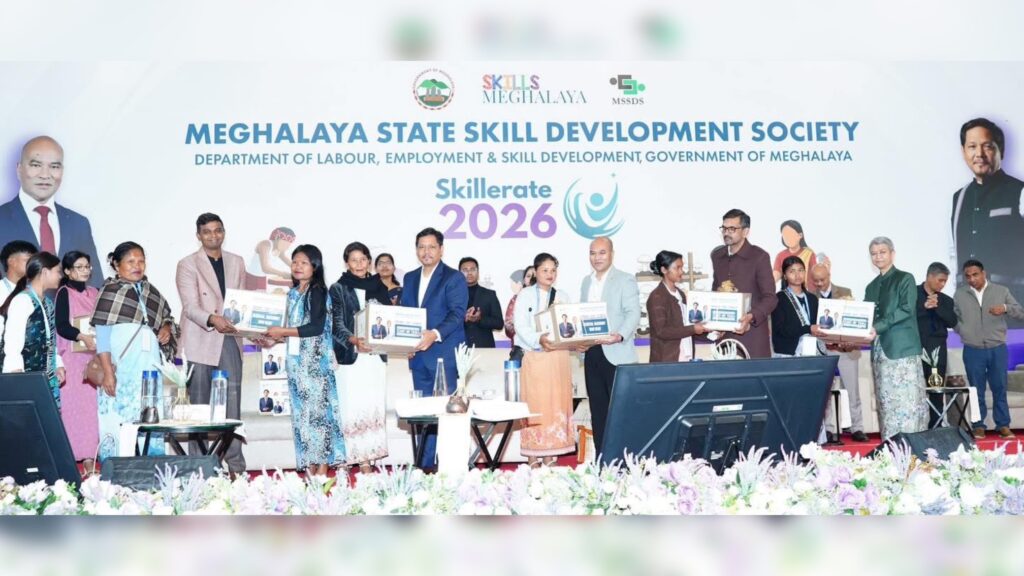
Shillong, May 13: The Meghalaya government on Tuesday launched an expanded skilling initiative under “Skillerate 2026”, unveiling four flagship programmes aimed at strengthening employment opportunities, entrepreneurship, and livelihood support for the state’s youth.
The event, organised by the Department of Labour, Employment & Skill Development along with the Meghalaya State Skill Development Society (MSSDS) and Skills Meghalaya at North-Eastern Hill University, comes at a time when nearly 60,000 young people enter the workforce in Meghalaya every year.
Addressing the gathering, Meghalaya Chief Minister Conrad K. Sangma said the state’s youthful population presents both an opportunity and a challenge, stressing the need for large-scale job creation to sustain the economy in the years ahead.
“Having a younger population, even when we compare it with the rest of the country, poses many more challenges compared to other parts of the country. Meghalaya is a young state where 50 percent of our population is below the age of 20,” the Chief Minister said.
He stated that around 60,000 individuals join the workforce annually and the number is expected to rise further in the future. According to him, the Meghalaya Skills Programme has been structured to cater to the diverse aspirations of the youth, whether they wish to work locally, move to Indian cities, or seek opportunities abroad.
Highlighting successful placement outcomes, Sangma cited examples of youth from Meghalaya securing jobs at JW Marriott in Mumbai and nurses from the state currently working in Japan. “Our objective is to avoid any form of forceful migration to get jobs,” he said.
A key focus of the programme is post-training support. The Chief Minister announced that nearly 21,000 trainees would receive startup toolkits worth around ₹24 crore, with each toolkit valued at approximately ₹9,000.
The toolkit distribution is part of PROPEL (Post-training Resources for Occupational Progress and Enhanced Livelihood), one of the four major programmes launched during the event. The other schemes introduced were MEGASKILL, SHIELD, and EQUIP.
Under PROPEL, the government announced ₹36 crore for startup toolkits, ₹3 crore for mobility support, ₹10 crore for salary augmentation, and ₹1 crore for market and industry linkages to help skilled youth transition into sustainable livelihoods.
MEGASKILL aims to identify and mentor talented youth for the WorldSkills Competition 2028 in Japan through district and state-level competitions, while SHIELD focuses on professionalising the caregiving and home-support sector through training, certification, and placement support. EQUIP, meanwhile, targets vulnerable groups including children in institutional care, persons with disabilities, inmates, domestic workers, and marginalised labour communities through specialised skilling interventions.
Labour, Employment and Skill Development Minister Methodius Dkhar said the state’s skilling initiatives are aimed at transforming the aspirations of young people into sustainable livelihoods and entrepreneurship opportunities. He also encouraged the youth to embrace the dignity of labour and not be discouraged by humble beginnings.
MSSDS CEO Dr. Vijay Kumar D., IAS, said the state’s skilling ecosystem underwent a major transformation after the Covid-19 pandemic, with Meghalaya moving beyond externally sponsored programmes to develop its own state-level skilling policy.
He added that the government shifted focus towards local training providers, resulting in the growth of nearly 150 local training centres across Meghalaya, collectively generating an estimated 2,000 to 3,000 jobs.
Over the last five years, more than 50,000 youth have been trained across different sectors in the state, with nearly 30,000 receiving certifications that enabled them to pursue self-employment and formal jobs.
The programme also marked the rollout of 2,500 startup toolkits to trainees trained and certified under MSSDS across several districts, including East Khasi Hills, West Khasi Hills, Eastern West Khasi Hills, South West Khasi Hills, West Jaintia Hills, East Jaintia Hills, and Ri-Bhoi district.